Visibility Is Not Recommendation: Why GEO Wins the Battle and Loses the War
By Saurabh Sachdeva, Founder & CEO, Assurex
There’s a gold rush happening in marketing right now. It’s called Generative Engine Optimization — GEO — and the pitch is everywhere. AI-visibility platforms will score how often your brand appears in ChatGPT answers. Agencies will sell you an llms.txt file, a token-reduction audit, and content restructured into the Q&A format that “answer engines prefer.” The pitch is familiar because it’s SEO’s pitch, re-skinned: make your pages more legible to the machine, and the machine will send you customers.
I think this playbook has a shelf life — and a short one. Here’s the contrarian case
The tactics work. That’s not the point.
Let me concede the obvious first: GEO tactics produce results today. When an AI assistant builds an answer through retrieval, clean structure and unambiguous product data genuinely improve your odds of being found, parsed correctly, and cited. Brands doing this work are seeing citation lifts. Anyone telling you it’s snake oil is arguing against observable results.
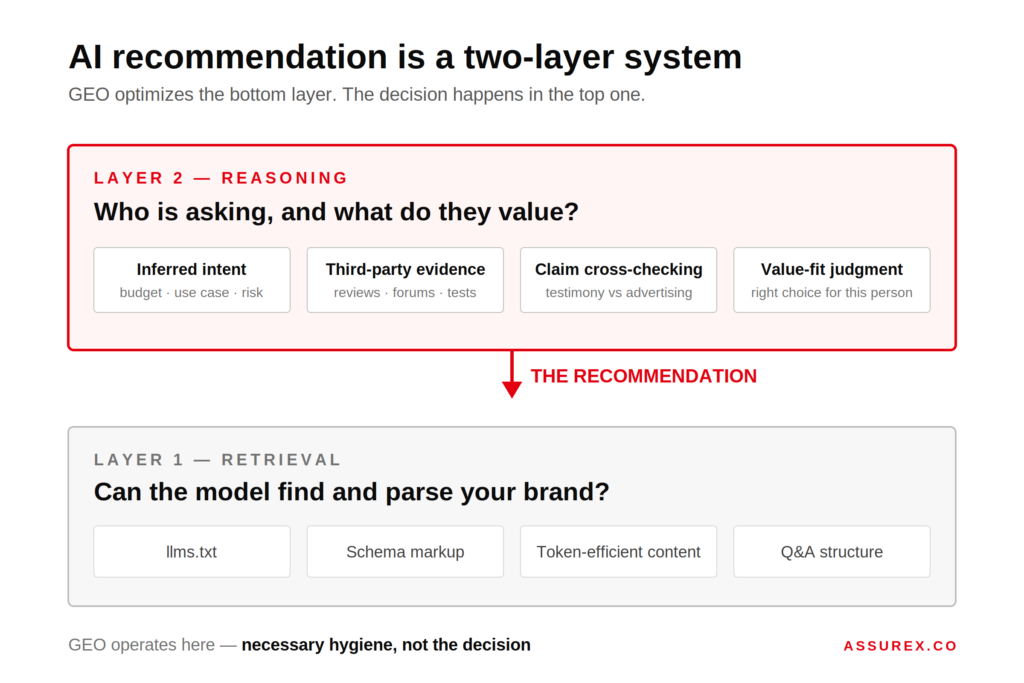
But being found and being recommended are two different layers of the system — and the second layer is where the money is.
The machine isn’t ranking pages. It’s reading people.
Ask an AI assistant to “recommend earbuds for someone who mostly takes calls and doesn’t care about audiophile sound,” and something happens that never happened in a Google search: the model builds a picture of the customer. Call-quality-first. Indifferent to premium audio. Probably price-flexible but not premium-seeking. Then it evaluates products against that person — weighing your product page against reviews, forums, teardowns, and comparison tests you don’t control.
Two consequences follow, and both break the GEO premise.
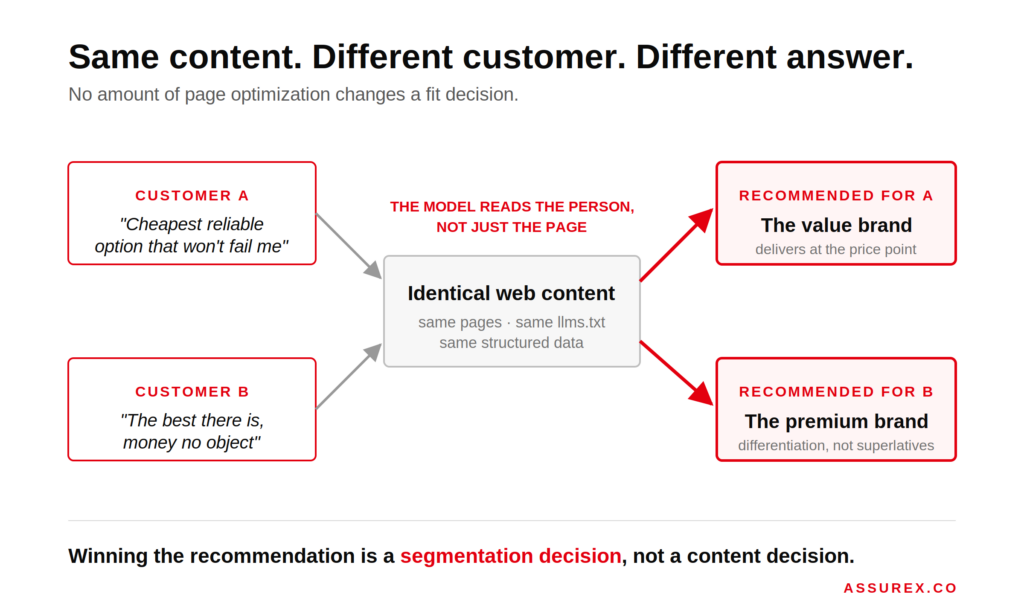
Identical optimization produces different outcomes. Two brands with equally pristine structured data will get different treatment depending on who’s asking. The premium brand doesn’t lose the cost-savvy customer’s recommendation because its content was less crawlable. It loses because the model judged it a poor fit. And no content change fixes a fit problem.
Your own claims are the least trusted evidence in the room. A model that can cross-check “best-in-class battery life” against independent testing will discount the claim the moment the corpus disagrees. On-page superlatives — the bread and butter of GEO copywriting — are exactly the signal class reasoning models are built to treat sceptically. Optimizing them harder is polishing a depreciating asset.
Today it reads the prompt. Tomorrow it knows the customer.
To be precise about what’s real now versus what’s coming: today’s intent inference is prompt-level. The model reads price sensitivity and use case from how the question is phrased. Someone asking for “the cheapest reliable option” and someone asking for “the best, money no object” get different recommendations from the same model over the same content. Try it yourself — same category, different framing, watch the brand list change.
What’s arriving next is persistent profiling — and with it, something bigger: agentic commerce. Memory features already carry preferences across sessions. The next step is assistants that don’t just answer product questions but transact: an agent that has watched a customer’s purchasing behaviour for months, learns their real preferences (not just their stated ones), shortlists options, compares prices across retailers, and completes the purchase — with the human approving a final choice, or not even that. The infrastructure is being built now: agent-driven checkout protocols, machine-readable product feeds, AI assistants embedded in payment flows.
In that world, three things change for brands. The recommendation engine knows your customer better than you do. The “shopper” reading your product page is increasingly a machine acting on a human’s behalf — one that is far less susceptible to urgency banners, hero imagery, and persuasion design, and reads mostly for verifiable substance. And the funnel you’ve spent two decades optimizing compresses into a single delegated decision you never see. Your content strategy can’t reach that decision. Only your actual value delivery — as recorded in the experiences of similar customers, everywhere on the internet except your website — can.
What I’d tell any brand asking us about AI visibility
Pick your customer, because the model will. An LLM resolving a cost-savvy query slots every brand into a value tier whether you chose one or not. Straddle segments with one undifferentiated offer and you’ll be inconsistently recommended to all of them. Segmentation now has to be real — pricing, configuration, service levels — because it’s being adjudicated by a third party that reads everything.
Invest in the corpus you don’t own. This is the genuinely new discipline. The decisive evidence in AI recommendation is third-party: Reddit threads, review aggregators, comparison articles, support-forum sentiment, independent benchmarks. To the model, that’s testimony; your website is advertising. Make it easy for genuine customers to review you. Publish specs third parties can verify. Resolve complaints where they’re publicly visible. Community sentiment is now a ranking factor.
State your trade-offs plainly. “Premium quality at a budget price” is precisely the claim pattern that gets discounted against external evidence. “The affordable option — here’s the price, here’s what’s included, here’s what you give up” is machine-verifiable positioning. Verifiable positioning is what survives the reasoning layer.
Do the technical work — as hygiene. llms.txt, schema markup, efficient structure: do them, the way you’d keep an accurate product catalogue. They make sure the model understands what you sell and to whom, and they reduce stale or hallucinated claims about your brand. What they don’t do is make you the recommendation. A year ago I wrote about how AI is transforming SEO — the shift from keywords to intent. That work still matters. But twelve months of watching this space has convinced me it’s the entry fee, not the differentiator. Budgets that treat it as a growth lever are buying a depreciating advantage.
The test I’d hold this argument to
I don’t want you to take this on faith — it’s checkable in an afternoon. Pick a category with clear budget/premium separation. Write paired prompts that vary only the customer: cheapest X that won’t let me down versus best X, money no object. Run them across ChatGPT, Claude, Gemini, Perplexity. Then score the recommended brands on the same GEO criteria the visibility platforms sell.
If I’m right, the recommendations will diverge sharply by customer framing — and you’ll find content optimization explains far less of the outcome than who’s asking does. If recommendations stay stable regardless of the customer and simply track optimization scores, then the retrieval layer still rules, and I’m early by more than I think.
The bottom line
The GEO industry is repeating SEO’s founding assumption — that the page is the unit of competition — in an environment where the unit of competition is the customer’s inferred value profile. The tactics work today because today’s systems are still retrieval-heavy. They’ll work less every year as reasoning, memory, and agentic commerce move the decision to a layer your content can’t reach.
The durable strategy is older than search itself: be genuinely the right choice for a defined customer, and make sure the evidence lives where the recommender looks — which, increasingly, is everywhere except your own website.
Agentic commerce — what happens when the AI doesn’t just recommend but buys — deserves its own piece, and it’s the next one in this series. If your digital estate isn’t ready to be read, compared, and transacted with by machines acting for your customers, that’s the conversation to start having now.
Saurabh Sachdeva is the Founder and CEO of Assurex, a digital engineering agency and Sitecore Platinum Partner with teams across London, Dubai, and India, helping enterprise brands build composable digital experiences.